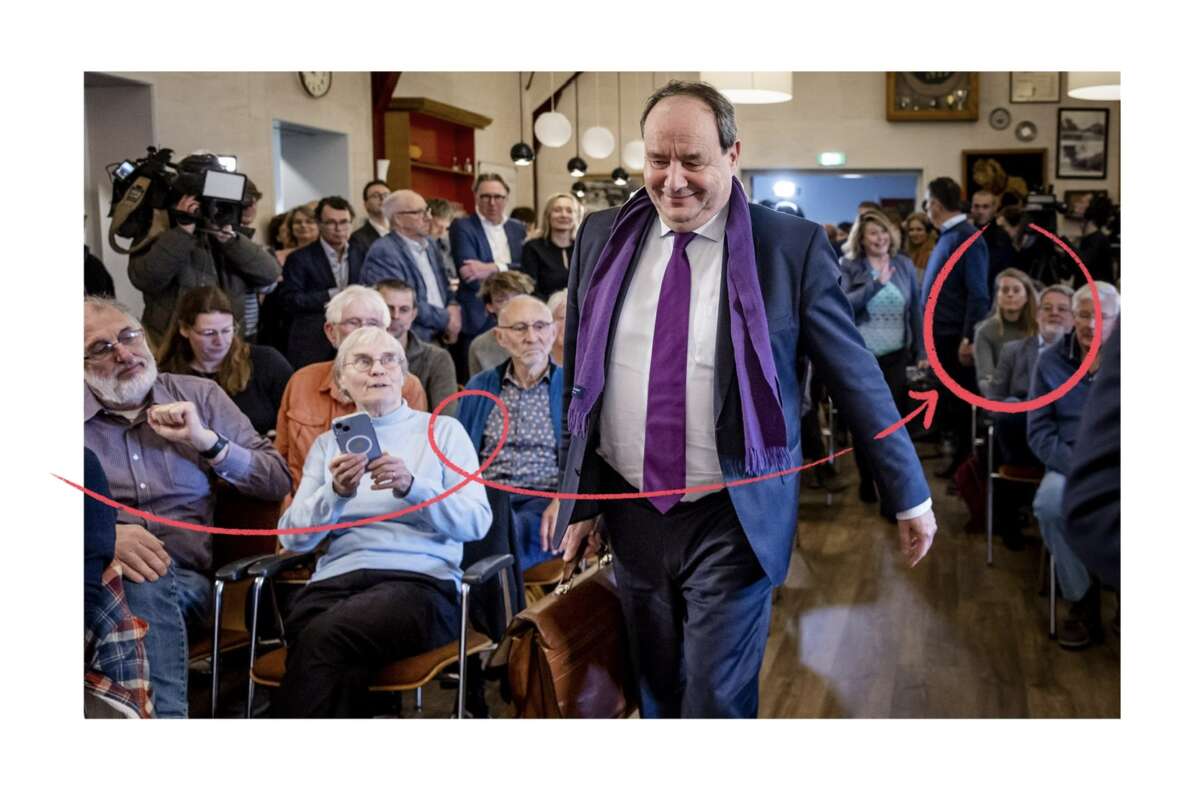
It’s funny when you follow a government official from one issue to the next. In this case, I’m talking about Hans Vijlbrief, the “Groningen guy” and now the new Minister of Social Affairs. It’s especially nice when a government official like that acknowledges that his views have changed, and he brings that new way of thinking and working to other issues—especially when you’re in the midst of writing your dissertation on that very approach.
If you want to follow my research, subscribe to my monthly newsletter.
Five years ago, I worked for the National Ombudsman and investigated the consequences of natural gas extraction. Our recommendation to the cabinet at the time was to appoint a separate minister to address the problems in Groningen. That minister turned out to be Vijlbrief.
Right from the start, he decided to hold monthly office hours in Groningen. At the ministry, they thought this was a crazy and unsafe idea, he writes in his book about that time. Still, he pressed on, and in the months that followed, he spoke with many people who were dealing with damage to their homes and the need to reinforce them.
After leaving my position at the Ombudsman’s office, I volunteered at the Groninger Gasberaad. There, I saw firsthand how these discussions helped build trust in Groningen. This allowed Vijlbrief to gauge public reaction to policy ideas at an early stage among the people who would be directly affected by them.
Listening to the soft voice
Around that time, I shifted my focus to the debt sector myself; I began my doctoral research in late 2022. As a case study, I then spent 2.5 years working with the Clustering Rijksincasso (CRI) partnership, which has been part of Vijlbrief’s portfolio since this week. At CRI, I investigated how the government can design policies and services with a human-centered approach: involving users, thoroughly understanding the context in which the services are used, devising solutions iteratively, and then testing those solutions with the people who will actually use them. As you can see, there’s an overlap with what Vijlbrief was experimenting with in Groningen.
In his book, Vijlbrief writes about his motto, “listening to the soft voice,” noting that he “has been changed as a person and as a politician by Groningen” and that “that lesson has broader applications.” Amen, brother. In my research, I see how listening to people can be made the standard approach for policy and public services within the government.
So, for him—and all the new ministers and state secretaries—here are 5 insights from my research to help them get off to a flying start in the coming cabinet term.
First: What is human-centered design?
Human-centered design is an approach to work in which you create something from the perspective of the people who will use it. Their experiences, needs, and context are not the end goal but rather the starting point for decision-making.
It means that you don’t just check whether a service is legally sound or technically functional, but also examine how policy plays out in everyday life. You make assumptions explicit, involve users early and repeatedly, explore tensions between rules and reality, and iteratively adapt solutions based on what you learn.

In my research, I use the ISO standard for human-centered design. It outlines six principles, which I have previously discussed in detail on this blog, along with examples from my research:
- Involve users continuously
- Understand the context of use
- Iterative making
- Testing Solutions with Users
- Starting from the whole experience of your target audience
- Multidisciplinary Work
How I Conducted My Research
At CRI, I worked for 2.5 years as an action researcher, collaborating with various teams that developed services for citizens with payment arrears, such as “Mijn Betaaloverzicht” and the “Betalingsregeling Rijk.” I observed how they gathered feedback from the field, used it to address collection and debt recovery services, and established partnerships with other organizations in the chain. I saw how they realized they needed a new mandate, funding, and policy. So, as a researcher, I followed them from implementation to policy, delved into political communication alongside them, and even interviewed a member of parliament.
I was allowed to observe everything and kept a detailed journal. The research could be (and still can be) followed through my monthly newsletter, in which I transparently reflected on every step.
Then there is the implicit question that Vijlbrief asked himself in his book: How can his lessons from Groningen be applied more broadly? Or, as I would like to phrase it in my dissertation: How can you design with people in mind within a complex political-administrative system?
1. Make it the norm to engage users
At the ministry, they initially thought it was a very unwise idea for Vijlbrief to hold office hours in Groningen. Can you really guarantee safety? What if, by listening and showing people things, you end up raising their expectations? In government, we find it very nerve-wracking to just strike up a conversation with people. As a user researcher working on my PhD, I’ve run into this myself many times.
But if we don’t talk to people, we have no idea what they need, and we can’t create something that meets those needs either.
In my research, I noticed that it was standard practice for the Mijn Betaaloverzicht team to meet with potential users every 3 weeks and publish their feedback openly. Mijn Betaaloverzicht is a digital application that allows citizens to view their payment arrears in a single overview and will become available to an initial group of users in 2026. Testing with real people is part of a regular work routine and makes it second nature to base decisions on user insights.
To make this the norm, there are two things you can do as a minister.
- Talk to the target audience yourself and ask your employees to actively seek out feedback and pass it on to you. After all, if the minister asks for it, everyone will spring into action.
- Give people the authority and freedom to adjust processes so that it doesn’t stop at occasional feedback. More on that in the third point.
2. Establish a mandate for usage preferences
Knowing what people need is important, but that doesn’t mean you can just act on that knowledge. To do so, implementing organizations need a mandate. And no one is better suited to secure that mandate than a government official.
You’ve already sent your people out into the field; now what they learn there needs to have an impact on policy. Compile the insights, back them up with data, and then bring them into the political conversation yourself: in the Cabinet, in a letter to Parliament, and in debates. Then give the implementing agencies a formal mandate (and funding) to act on the basis of those insights.
Here’s an example: as the CJIB began handling more and more debt collection cases on behalf of other organizations, they noticed that some citizens had overlapping debts. Someone might have both a health insurance payment in arrears and a traffic fine or an overdue student loan. This overlap could cause people to fall further and further behind.
To gain a better understanding of this, the CJIB asked the CBS to use data from service providers to assess the extent of this problem, which resulted in this dashboard. By making the overlap so clear, the minister at the time was able to put the issue on the agenda, and a political mandate to address this problem was inevitable. That worked out well, because the CJIB, DUO, and CAK were actually already prepared with a first version of a joint payment plan, for which they needed a mandate to offer it to citizens.
3. Take small steps
An iterative approach is essential if you want policies and services to align with users’ lived experiences. You only know if something works once you test it, and through testing, you often discover things you need to do differently. An iterative approach is therefore also uncertain. You don’t know in advance what something will be like when it’s finished. You take a first small step, and then immediately make adjustments. What if you already said “A” in a letter to Parliament, and now, after a round of testing, it turns out that “B” is actually better? This uncertainty makes it difficult for many policymakers to “steer” the process.
It works well if you agree in advance that uncertainty is okay and that everything doesn’t have to be finalized all at once. In my research, I found that—especially in projects involving policy changes—progress often stalled during lengthy coordination rounds. To keep the momentum going, the team working on the joint payment scheme scheduled a fixed annual meeting for policy updates at a certain point. This allowed them to take a step forward each year, created space to systematically incorporate user insights, and enabled the program to be expanded each year to include more and more organizations and citizens.
Don’t expect major “big bang” moments. Embrace the process of taking small steps. In fact, get actively involved and adopt an iterative approach to politics as well.
I realized that small, tangible results were more effective than long-term plans. Small steps were easier to “align” with the overall strategy, provided room for practical testing, and made the next step seem logical, because: this is how we do it now. The same mechanism worked politically as well: through letters to the Stas or the House of Representatives, operational steps also became political realities.
This is learning by doing. By linking each step to what has been proven to work in practice, you continually renew your mandate. Members of Parliament cannot see what happens within the government, but they can see what actually reaches people at home. Once a small step has been taken, you can build on it, as was the case with the expansion of MijnBetaaloverzicht to more government agencies through the Kat/Kathmann motion. This is a next step the team can tackle.
4. Make decisions based on the citizen’s overall experience
In Groningen, the case file consisted of an administrative tangle involving two ministries, multiple implementing agencies, national and local government, and all sorts of other parties that were entangled in and around the issue. It’s no different for people in debt. There are now sometimes multiple government agencies competing with one another to collect debt from the same person. This often only makes people’s problems worse, as I saw when I spent a day shadowing a bailiff.
The goal of the “Clustering Rijksincasso” program is for creditors to simplify this tangled web into a single, clear relationship between citizens and the government. Each citizen is one person and has one wallet.

To break down this fragmentation, we must design with the user’s entire experience in mind. This requires collaboration across legislative frameworks, funding streams, and lines of accountability. Tools such as the CBS dashboard help make the shared problem visible and unite decision-makers around a single vision. But the larger the scale, the more demanding the coordination and political maintenance required to maintain coherence.
Take the citizens’ overall experience as your starting point and make decisions that span different domains. Choose organizational structures that can orchestrate this design process like a conductor.
I find it very promising that Vijlbrief has taken on “separate” policy issues such as the right to exist, purchasing power, poverty, and debt.
5. Implement changes directly in the production line
We often set up new ways of working as separate projects so that the core operations remain protected. In the public sector, we can’t afford to follow the tech bro motto “go fast and break things.” That’s why we often feel the need to ensure that innovation and change are completely safe before we implement them.
In my research, I found that combining these approaches works well. Safe lab settings provide room for exploration, citizen engagement, and generating new ideas. But this lab setting shouldn’t be too safe or isolated, because then it won’t reach the public. To achieve that, you have to work as closely as possible to the front lines: to translate results into policy, systems, and (political) accountability. And so that citizens can actually apply for a new program or, for example, view their payment statement on their phone.
People-centered design requires innovative settings that aren’t too safe and policy implementation processes that aren’t too rigid. Create space for learning within the process to bring about change in small steps.
Continue reading?
This summer, the first of two academic articles using the Rijksincasso clustering project as a case study will be published, in which I will share the insights mentioned above in detail, among other things. If you’d like to receive it in your email (along with the accessible summary) as soon as it’s published, please subscribe to my newsletter.
Other recommended reading:
- Hans Vijlbrief (2024). The People of Groningen Were Always Right, Prometheus Publishing.
- Trust alone is not enough. Summary of the first article from my PhD thesis on eight years of practical experience in public service. Topics include the student loan system, the CoronaMelder app, and how civil servants make well-considered decisions.

